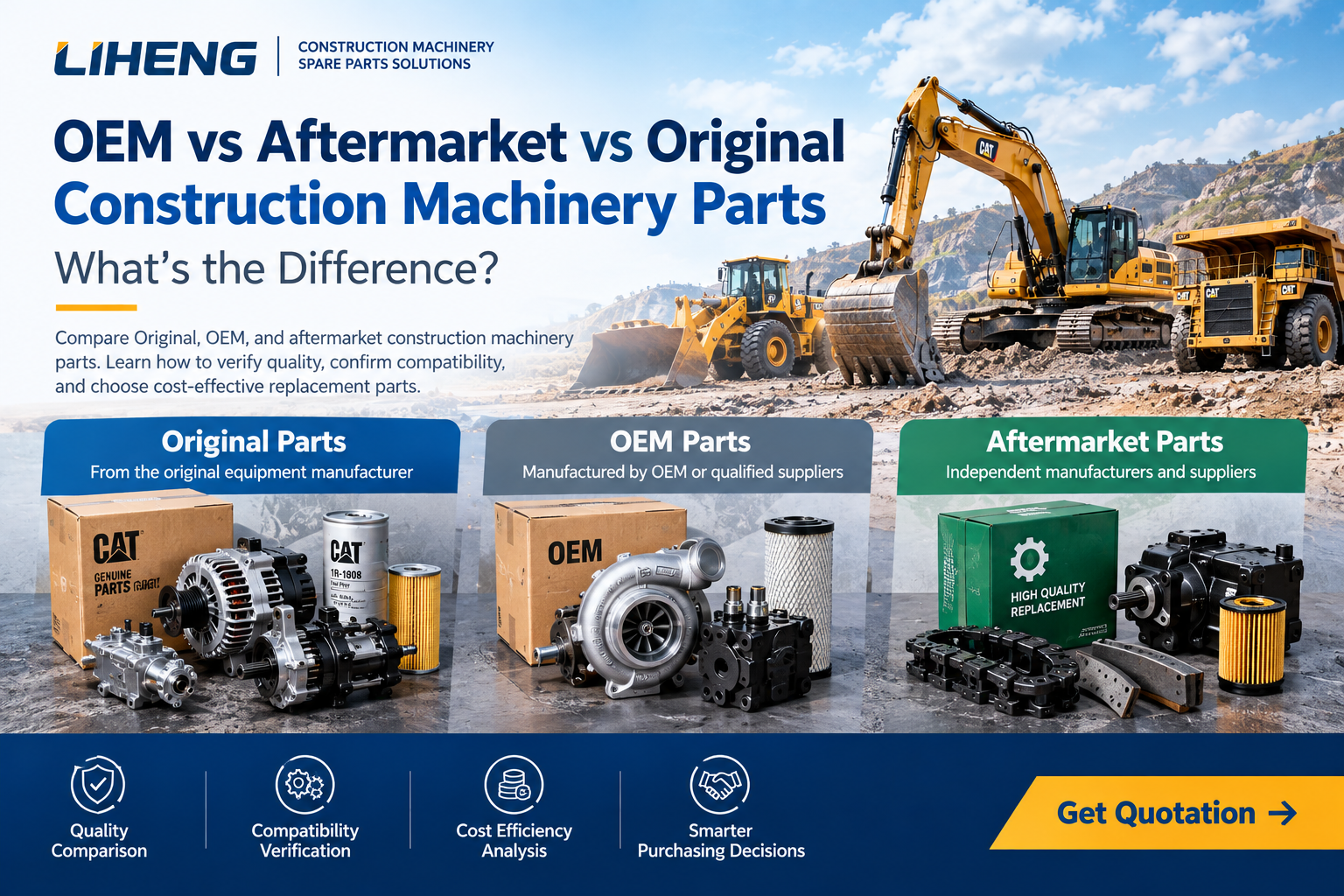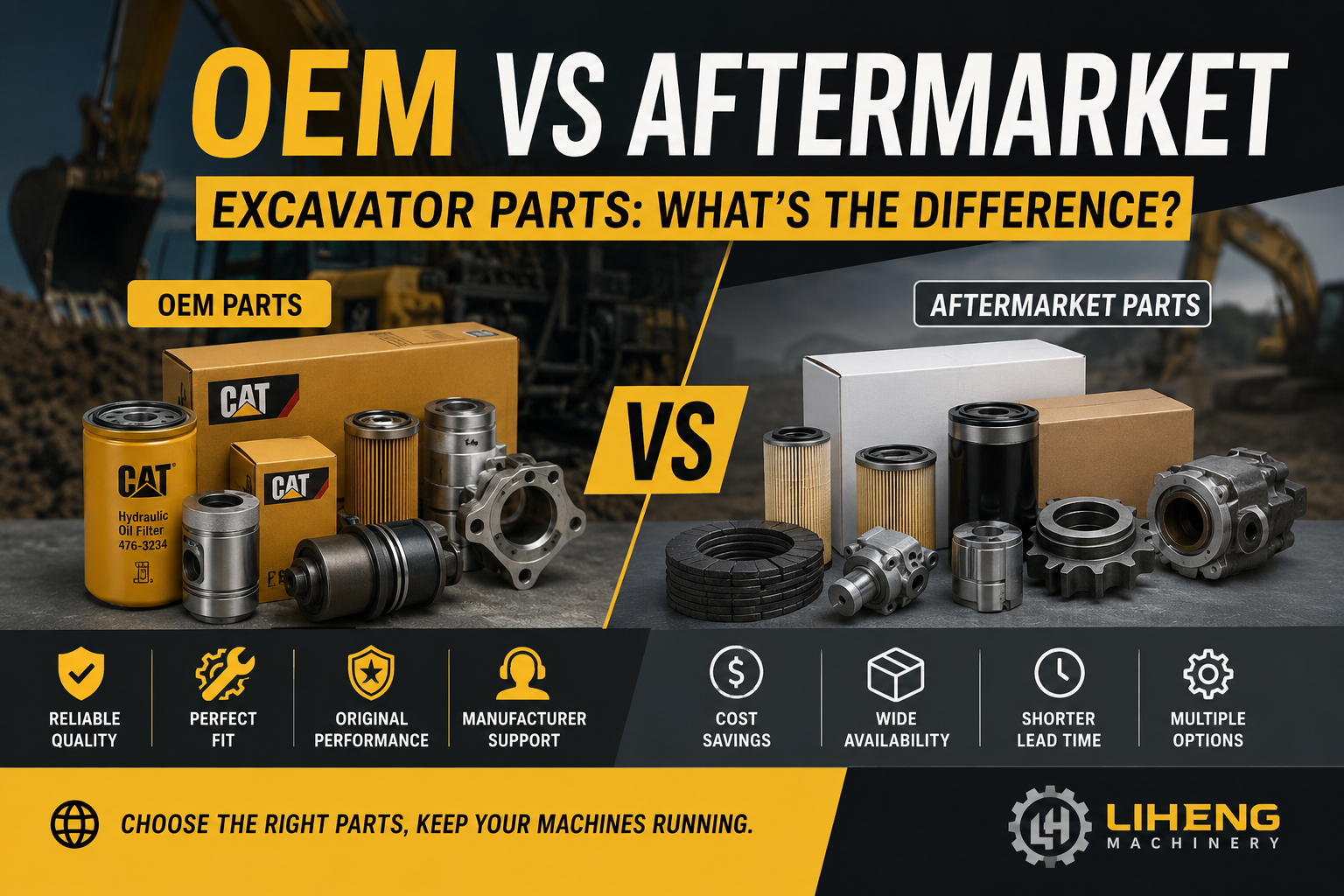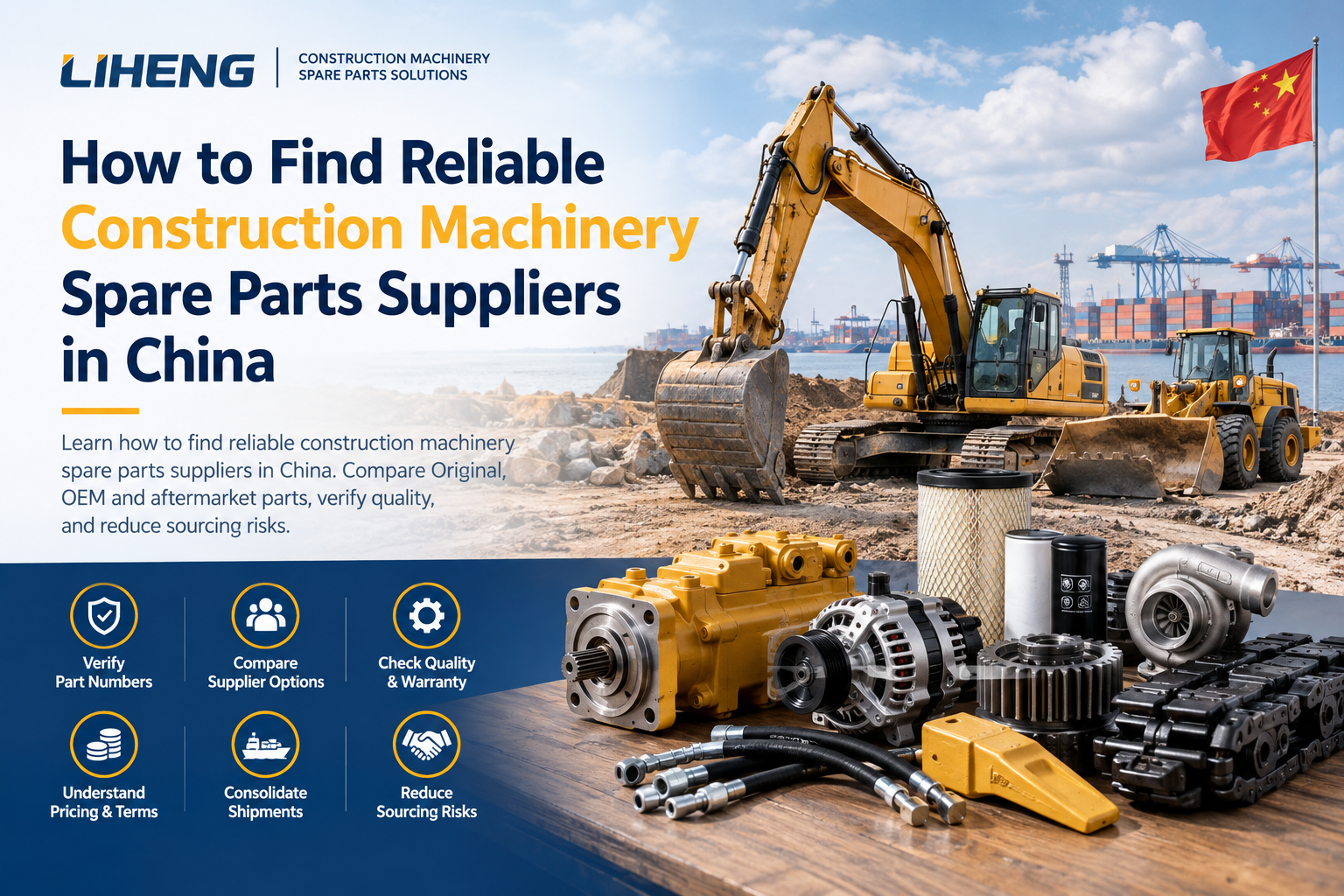
Learn how to find reliable construction machinery spare parts suppliers in China. Discover how to verify part numbers, compare Original, OEM and aftermarket options, evaluate suppliers, control quality and reduce sourcing risks.
Finding a reliable construction machinery spare parts supplier in China can significantly reduce purchasing costs, shorten sourcing time, and improve parts availability. However, choosing the right supplier is not simply a matter of finding the lowest price.
For excavators, wheel loaders, bulldozers, mining equipment, drilling rigs, underground loaders, and other heavy machinery, the wrong spare part can lead to installation problems, premature failure, unexpected downtime, and additional transportation costs.
This guide explains how to find and evaluate reliable construction machinery spare parts suppliers in China, what information to provide when requesting a quotation, and how to reduce sourcing risks.
1. Why Buy Construction Machinery Spare Parts from China?
China has a large and highly developed supply chain for construction and mining machinery components.
Depending on the equipment and part required, Chinese suppliers can provide:
Engine spare parts
Hydraulic components
Undercarriage parts
Electrical components
Cooling system parts
Transmission and drivetrain components
Final drive and travel motor parts
Cab and body components
Filters and maintenance parts
Mining equipment spare parts
Drilling rig components
Underground LHD loader parts
One of the main advantages of sourcing from China is that buyers can compare products from different manufacturers instead of depending on a single local supplier.
However, this advantage also creates a challenge: there are many suppliers with different levels of quality, experience, and after-sales support.
The key is therefore not simply to find a Chinese supplier.
The goal is to find the right supplier for your specific part and equipment.
2. Manufacturer or Trading Company: Which One Should You Choose?
Many international buyers assume that purchasing directly from a factory is always the best option.
This is not necessarily true.
For standard, high-volume products, buying directly from a manufacturer can be an excellent choice. But construction machinery spare parts are often different.
A customer may need 5 different parts for a CAT excavator, 3 hydraulic components for a Volvo loader, and several engine parts for a Perkins engine.
These parts may come from completely different factories.
In this situation, working with a professional spare parts sourcing company can be more efficient than contacting ten or twenty factories individually.
A capable sourcing company can help with:
Part number identification
Supplier selection
Product comparison
Original, OEM and aftermarket options
Quality verification
Purchasing consolidation
Domestic transportation
Export documentation
International shipment coordination
This is particularly useful when a buyer has a mixed spare parts order.
The important question is not:
“Is this company a factory?”
The more useful question is:
“Can this supplier reliably provide the correct part with the required quality, documentation and delivery?”
3. Always Start with the Correct Part Number
The most important information when purchasing heavy equipment spare parts is usually the part number.
For example, a request such as:
“I need a hydraulic pump for a CAT excavator.”
is not enough information to guarantee the correct product.
A better inquiry would include:
Machine brand
Machine model
Serial number
Part number
Engine model
Photos of the original component
Nameplate information
Required quantity
The part number allows the supplier to search its supplier network and compare possible sources.
However, part numbers can sometimes be superseded, replaced, or used differently between machine versions.
Therefore, a professional supplier should not rely only on a quick keyword search.
Recommended information to provide
Information | Importance |
|---|---|
Part number | ★★★★★ |
Machine model | ★★★★★ |
Serial number | ★★★★★ |
Original part photo | ★★★★☆ |
Nameplate | ★★★★☆ |
Quantity | ★★★★☆ |
Application | ★★★☆☆ |
The more accurate the information, the lower the risk of receiving the wrong part.
4. Ask for Different Quality Options
There is rarely only one purchasing option for construction machinery spare parts.
Depending on the application and budget, buyers may consider:
Original Parts
Original parts are supplied through the original equipment manufacturer’s supply chain or authorized channels.
They are often the preferred choice for critical components where reliability is the highest priority.
However, original parts can also have higher prices and longer lead times.
OEM Quality Parts
OEM-quality products are manufactured to meet specified technical requirements and can be a practical alternative for many applications.
The exact meaning of “OEM” can vary between suppliers, so buyers should ask for clear information about the manufacturer and quality standard rather than relying only on the label.
Aftermarket / Replacement Parts
Aftermarket parts are produced by manufacturers other than the original equipment manufacturer.
A reliable aftermarket supplier should be able to provide clear information about:
Manufacturer
Material
Manufacturing process
Compatibility
Warranty
Quality control
Available stock
For some non-critical components, a good-quality replacement part can offer an attractive balance between price and performance.
5. Do Not Compare Suppliers by Price Alone
A common mistake is to collect three quotations and immediately choose the lowest one.
For heavy equipment spare parts, this can create problems later.
When comparing quotations, consider at least:
Product quality + compatibility + delivery time + warranty + supplier reliability + total cost
For example, Supplier A may quote USD 500 while Supplier B quotes USD 650.
But Supplier A may offer a generic replacement with a short warranty, while Supplier B provides a verified replacement from a more established manufacturer with better quality control.
The USD 150 difference may be insignificant compared with the cost of equipment downtime.
A better quotation comparison
Ask every supplier to provide:
Exact part number
Product brand
Product origin
Quality level
Quantity
Unit price
Delivery time
Warranty
Packing method
Shipping terms
Country of origin documentation, if required
This allows you to compare products on an equal basis.
6. Check Whether the Supplier Understands Heavy Equipment Parts
A supplier may have excellent English communication and competitive prices but still lack the technical knowledge required for heavy equipment parts.
Before placing an order, test the supplier.
Give them a difficult part number and ask:
Can you confirm the application and compatibility?
A capable supplier should be able to investigate the part rather than simply reply:
“Yes, available.”
For complex components, the supplier may need to check:
Machine model
Serial number range
Component number
Manufacturer information
Replacement or superseded part numbers
Technical drawings
Supplier catalogues
Photos and dimensions
This is particularly important for hydraulic components, engine parts, electrical components and mining equipment parts.
7. Ask for Real Product Photos
Before purchasing, ask the supplier to provide actual product photos whenever possible.
Useful photos include:
Overall product
Nameplate
Part number marking
Packaging
Manufacturer label
Critical connection points
Dimensions, when relevant
Real photos can help verify whether the product being quoted is actually the same product being supplied.
For expensive components, buyers can also request additional inspection photos or videos before shipment.
8. Understand EXW, FOB and Other Trade Terms
International buyers should also pay attention to the quotation terms.
Common terms include:
EXW
The supplier makes the goods available at its premises.
The buyer or buyer’s forwarder normally handles transportation from the supplier’s location onward.
FOB
The seller handles the necessary export procedures and delivery to the agreed port, while the buyer handles the main international transportation.
CIF
The seller arranges transportation and insurance to the named destination port.
For spare parts sourcing, EXW and FOB are often useful for buyers who already have their own freight forwarder or logistics network.
Always confirm exactly what is included in the quoted price.
9. Consolidating Spare Parts Can Reduce Logistics Costs
One major advantage of working with a sourcing company is order consolidation.
Suppose a buyer needs:
Excavator engine parts
Hydraulic components
Filters
Electrical parts
Undercarriage components
These products may come from several Chinese suppliers.
Purchasing everything individually can result in:
Multiple domestic shipments
Multiple packing lists
Multiple export arrangements
Higher international freight costs
More complicated customs procedures
A professional sourcing company can potentially consolidate different purchases into one shipment.
This can be especially useful for fleet owners, equipment rental companies, dealers and machinery parts distributors.
10. How to Evaluate a Chinese Spare Parts Supplier
Before placing a significant order, evaluate the supplier using several criteria.
1. Product Knowledge
Does the supplier understand construction machinery and spare parts?
2. Supplier Network
Can they access multiple qualified manufacturers rather than relying on one source?
3. Part Identification
Can they verify compatibility and identify alternative part numbers?
4. Quality Control
Do they inspect products before shipment?
5. Communication
Can they provide clear and consistent information?
6. Documentation
Can they provide commercial invoices, packing lists, certificates or other documents when required?
7. Warranty
Is there a clearly defined warranty policy?
8. Export Experience
Does the supplier understand international shipping and export requirements?
A supplier that performs well across these areas is generally more valuable than one that simply offers the lowest price.
11. Red Flags When Buying Spare Parts from China
Be careful if a supplier:
Gives an unusually low price without explaining the product quality
Cannot provide the exact part number
Refuses to provide product photos
Changes the manufacturer after receiving payment
Cannot explain the difference between Original, OEM and aftermarket products
Provides inconsistent information about delivery time
Avoids discussing warranty
Cannot provide basic export documents
Claims that every product is “100% genuine” without evidence
Pressures you to make immediate payment
A professional supplier should be willing to explain the product and quotation clearly.
12. What Information Should You Include in a Spare Parts Inquiry?
To receive a faster and more accurate quotation, prepare your inquiry in a structured format.
For example:
Machine: CAT 966GC
Part Number: XXXXXXX
Part Name: Hydraulic component
Quantity: 2 pcs
Quality Required: Original / OEM / Aftermarket
Destination: Oman
Required Delivery: As soon as possible
If available, also attach:
Original part photos
Nameplate photos
Machine identification plate
Parts diagram
Previous supplier quotation
This gives the supplier enough information to investigate the correct product.
13. Why a Multi-Supplier Sourcing Network Matters
A strong spare parts supplier does not necessarily manufacture every product.
Instead, the supplier may have access to specialized manufacturers in different regions of China.
This can be particularly important because different areas of China’s industrial supply chain have different strengths.
For example, one manufacturer may specialize in engine components, another in hydraulic parts, while another focuses on undercarriage or mining equipment components.
A sourcing company with an established supplier network can compare these options and select the most suitable source for each part.
This is one of the key differences between simply buying from an online marketplace and working with an experienced machinery parts sourcing partner.
14. Why Choose LIHENG Machinery?
Guangzhou LIHENG Machinery specializes in construction and mining machinery spare parts sourcing.
Instead of limiting customers to a single manufacturer’s product range, LIHENG works with specialized suppliers across China’s machinery parts supply chain.
Our sourcing process focuses on:
Part Identification → Supplier Matching → Price Comparison → Quality Verification → Consolidated Purchasing → Export
We can assist customers with spare parts for:
Excavators
Wheel loaders
Bulldozers
Mining excavators
Dump trucks
Underground LHD loaders
Drilling rigs
Construction machinery
Mining machinery
Our product categories include:
Engine Parts
Hydraulic Parts
Electrical Parts
Cooling System Parts
Undercarriage Parts
Transmission Parts
Mining Equipment Parts
Other Construction Machinery Spare Parts
Whether you need one difficult-to-find component or a complete mixed spare parts order, our team can help identify suitable Chinese supply sources and compare available options.
15. Final Checklist Before Ordering
Before confirming your purchase, make sure you have checked:
☐ Correct part number
☐ Correct machine model
☐ Serial number compatibility
☐ Product quality level
☐ Manufacturer information
☐ Actual product photos
☐ Unit price
☐ Quantity
☐ Delivery time
☐ Warranty
☐ Packing method
☐ Trade term
☐ Shipping arrangement
☐ Required export documents
Taking a few extra minutes to verify these details can prevent much more expensive problems later.
Conclusion
Finding a reliable construction machinery spare parts supplier in China is not simply about finding the cheapest quotation.
The right supplier should be able to identify the correct part, access suitable manufacturers, compare different quality options, control product quality, consolidate purchases, and support international delivery.
For buyers purchasing excavator, loader, mining, drilling or underground machinery parts, a reliable sourcing partner can save both time and money while reducing the risks associated with incorrect or poor-quality components.
If you have a part number, machine model, photo, or parts list, send it to LIHENG Machinery.
We can help you identify the part, check Chinese supply sources, compare Original, OEM and aftermarket options, and provide a quotation based on your requirements.
Need help sourcing construction machinery spare parts from China?
Send us your part number or parts list for a quotation.